Plaques and Plinths,
The Scots Football Historians' Group
(serious football history, factual facts and stats with actual numbers)

Newish:
Football's Four Miles - Vale of Leven and The Dunbartonshire Rangers+
the stories of the The Vale's, Renton's, Dumbarton's and wider Dunbartonshire's unique roles in the birth of the Glasgow, Scottish, English and World's game and the men who made it happen.
And for balance:
All SFHG Glasgow's Trails and others available right now with the Edinburgh Ambles coming soon.
Also The World Championships (1872-1904) -- ELO - and then Proper Analysis
Available now:
and The Chile Eight, our Scottish circuits for the two countries.
And just added;
The Source and Resource of the Latin American Game
The Source and Resource of the Spanish Game
Plus:
The Brazil Circuit and Argentine Cled
the full route and story of the six Scots, who made Brazil's game and Argentina's twenty-one.
----------------------------------------------------------------------
Robert Parlane's Grave Restoration
- Almost there
Some months ago the SFHG re-found the grave of Robert Parlane, winner of two, consecutive Scottish Cups and Scotland's third ever, international goalkeeper. He had won his caps whilst playing for Dunbartonshire's Renton but work took him to Belfast, life and family took over and it is in that city that he died and is buried in a grave that a wee while ago looked as was being restored, stage by stage, as an SFHG initiative and at our expense.

As Was

As Also Was
And this is how it looks just now, cleaned, tidy, respecting of the man and what he did. And all it needs is a matching ceremony. Watch this space.

This is just part of the work the we at the SFHG initiate and carry out and there are more graves of similar importance to Scottish and Scots global football history that are in a similar poor condition and which we hope to get to. And, of course, any money to help this work is greatly appreciated. For details of our Donations Account simply click here.
And: Andrew Watson Grave Preservation
The grave of Andrew Watson, the World's first Black international footballer and captain of Scotland's national team was re-discovered by Andy Mitchell, was restored with considerable private crowd- and personal-funding through SPHG and with maintenance since commissioned and paid for by us too.
That was already five years ago. Just now the maintenance contract is due to be renewed and shall be. We will make sure of that but you can help us and by making a donation. To do so and conserve and preserve Scottish and Scots football history more widely all that is required is to click here on donations and send whatever you think appropriate and within your your means. Whatever it might be you have our grateful thanks, our appreciation and the knowledge that every penny will be used for this and for other similar projects like the Robert Parlane one above with more to come - Cheers

----------------------------------------------------------------------
QPNae-Pals
and how West Dunbarton Made Modern Football
Modern football is a working-class game, a game of the people; equally so in Scotland as globally. In fact modern, global football is the working-class game because of Scotland. That Association football began in it with Glasgow's Queen's Park is not in doubt. That for four years from foundation in 1867 the club was Billy-Nae Pals is just as clear. Eight games in the two years from 1868 and none really to the London Rules, then three more in 1871 and of them probably only one to the same.
That is until two events. Firstly QP was, it is said by a visit and an exhibition game, able in the Vale of Leven to convert one club, Alexandria's Vale of Leven itself ("The Vale"), from the oval-ball stramash, it then playing the Glasgow club three times in as many months, and cause the creation of two more, Dumbarton and Renton, probably in that order. And it was this last club, quite possibly because of the less than friendly attitude of Dumbarton to Vale of Leven, which reached the 1874 Scottish Cup Final. There, almost a decade before England, a barely nascent working-class team met the already doyen, middle-class one and lost. But that would not be the case for long.
However, whilst Glasgow had come to West Dunbarton there had also been significant movement the other way. Initially it had been with John Carson from Helensburgh to Queen's Park itself. That is before he headed South to Birmingham and founded that city's first major club, Calthorpe. And then there was Rangers. It is incontrovertible that without Rhu, in fact Shandon to Helensburgh once more, there would not have been the Ibrox club. Of the four founders three, the two McNeil brothers, whose elder sibling, Henry, had already ploughed the Clydeside furrow, and Peter Campbell hailed from there. And they would soon be followed to make up the new team by a further McNeil, more Campbells and, from the same source, two Vallances, first Alex and then Tom, the latter actually Renton-born.
Furthermore, when the first Scots went South with their home-honed skills the same Peter Campbell would be amongst the first half-dozen, the first to Blackburn, paving the way for that club's emergence as England's initial enduringly successful working-man's team. And there would be more. After Vale of Leven had eclipsed Queens Park in the Cup, in 1883 Dan Friel would be the first of its players to follow the same route, to Accrington so also North-West Lancashire, to be followed the following season by Sandy McLintock and in 1885 by Robert MacRae, both to Burnley, so that corner of Lancashire once more.
But it would be a trickle. That is until in 1888 a for a period dormant but now revived Renton exploded onto the national and then international scenes. Until that year from its team only Alick Barbour had taken the English shilling, in 1887, just one of just over a hundred to have done done that year, and to Bolton Wanderers, so Lancashire again, before moving on to Glossop and Nottingham Forest. Yet from the moment Renton won not just the Scottish Cup but in defeating both the English FA Cup holder, West Bromwich, and the next's season's, Preston North End became de facto World Champion over the next seven years about eighty players would join him from not just Renton but also The Vale and Dumbarton, more than a team a year from a valley population of perhaps 25,000. And on this occasion over the fifteen seasons from that same 1888 to the end of the century the penetration with the unique, local, Leven style of play would be far beyond that of their predcessor, indeed predecessors; onto Merseyside, deep into the English Midlands, into the burgeoning clubs of the Tyne, the Wear and the Tees and eventually even to London and the South.

Proper research and the purple, the Scottish blue on English red, dots speak for themselves.
----------------------------------------------------------------------
One Lion, Rampant Once More
When the first World Cup was played the Final was competed for by two teams, Uruguay and Argentina, whose football could be traced diredtly to Scots and the Scottish-game. And in the two following finals the runners-up could do the same either again directly (dark blue) or through the still first-hand filter of Jimmy Hogan and others (lighter blue), subjects already for another place and day. But Italy was the winner on both occasions and, whilst administratively Geo Davidson was in that country instrumental no similar on-field claim would have any justification. There Vittorio Pozzo was playing his for two-tournaments-unchallenged, still more defensive version of the 2-3-5 English game.
However, the Scots-game would reassert itself in 1950, was expected to do so in 1954 with the Hungarians but stumbled to the inscrutible at the so-called Battle of Berne but came again in 1958 and 1962. Yet that was to be it. Apart from arguably 1974, 1978 and 2016, the discussion being about how Scots was Dutch Total Football, again one for another place and time. Otherwise in the interim World Cup Finals have either been largely non-Scots or a face-off between Scots and non -, the latter with parity until recent times when non-Scots seemed with 2006 and Italy and France and France and Croatia in 2018 to have gained the upper-hand. Certainly in the last ten World Cups the champions have non-Scots six times, whereas in the first ten it was just four.

But with this World Cup there has been change, reversion even. For the first time since 1962 two teams - Spain and Argentina - with football of impeccably Scots origin face each other in the Final. In the former's country's case its oldest team, its doyen, the equivalent of our Queen's Park, Recreativo de Huelva, was founded by three of our countrymen, its oldest ground, that of newly-promoted Aguilas is in theory still owned by a long-dead Scot but bequeathed to the town as long as sport, football, continues to be played on it, and Barcelona football would probably not exist without first Paisley's Borgonya and then F.C. Escoces. And in the case of the latter country it was not one but four and twelve plus Scots or Scots Diaporans respectively, who each in their way but through a Caledonian passion for it gifted the game to both shores of the River Plate; the quartet to Uruguay's Montevideo and in Argentina a baker's dozen to first Rosario, the home-town of Messi, and then to Buenos Aires, Cordoba and beyond.
So at the highest level of the international game this year for the first time in almost three quarters of a century it is literally and also purely "No Scots, no Soccer". And, whilst our national team might this time have fallen early, at the finale the game we, wee Scotland, not just promulgated but created is very much still there; beautiful and kicking.
----------------------------------------------------------------------
New Insights
- or Scots Enlightenment despite The QP Fallacy
If you think 2-3-5 was an English or even a Welsh invention then you're wrong.
For more reality click above and read on.
Then there is always:
A New and Scottish Historiography of Association Football (Part 1)
(The Story and Analysis of How Scotland and Scots made the Game, the English Game and More)
- now available by clicking on above.
The Latest Research
Early Edinburgh Football
On the 11th, 12th and 13th June the FootyCon 2026 Conference was held in London. At it the always excellent Andy Mitchell presented a paper essentially on the early history of football in Edinburgh, concentrating this time on The Meadows and showing it began as early as the late 1850s and suggesting it as a continuation of the growing understanding of the non-mob, "traditional Scottish game".
For Andy's blog click here and then click on the link within it for the full presentation.
______________________________
Statement
This site is dedicated to the serious, fact-based exploration of Scottish football, that is the modern game largely created here, and Scots football, taken to the World in passion, minds and feet by our forebears, largely amateur in the true sense, who in so doing created the beautiful, global game. Our aim is to un-cover and relate the real stories of and backgrounds to this passion for the World game and preserve the legacies no matter what and where globally. We research, spotlight, advocate, mark, preserve and restore, all voluntarily. Now we even comment, so before scrolling on to enjoy or use our content first consider a donation.
SFHG Aims
- - to continue, aid and enlarge the research done by us and serious others on the Scots contribution home and abroad to the World game and post it here on-line, a site which, as our own time allows, we are constantly building.
- - to honour on-line and in the media with biographies and articles by us and significant others and wherever possible physically, at home and abroad with plaques and restorations, those many Scots who have made important contributions at all levels to that same World game.
- - in Scotland itself to encourage the exploration by all those with interest of Scotland's remarkable, indeed pivotal, global contribution to that same World game.
To do this final one we began with the creation of a series of virtual, footballing trails, The History Trails, and, within some, community Rambles, Strolls and Drive-Throughs, that can be followed on foot or by car just as we have done. See above.
And finally we hope that our work will catch the attention, as it has already again both at home and abroad, of still more descendants of those same contributors, and encourage them to come forward to accept proudly the accolades due to their forebears.
_______________________________________________________________
Update - Designation Approved!
Hampden Bowling Club, the site of the First Hampden Park - Scotland's, your and the World's first football stadium specifically for football

Even Better News:
The proposal for designation for the Hampden Bowling Club/Kingsley Gardens site of the 1st Hampden Park has been approved by Historic Environment Scotland. For technical reasons the bowling club itself and its even its sward cannot be covered but the foundations of the original Hampden Pavilion in Kingsley Gardens and at the north-west corner of the original pitch can, ruling out full-site and thus effectively full-scale development.
And it is SFHG and other important historians of the Beautiful Game, who have spotlighted this as a problem and contributed to the solution that has now been found.
_________________________________________________________________________
Latest News of Spain's Scottish Clubs
So just now for two of them, both for now in the same league and division, there is good new and even better news.

First, Recreativo, Spain's oldest club, founded in the Andalusian city of Huelva by Scots, William Alexander Mackay, Charles Adam and Gavin Spiers, has ended the season in fifth place but that has meant by a point the play-offs have been missed.

But Aguilas in Murcia, with Spain's oldest football ground and founded by John Gray, took third spot, has played two play-off games so far and won them both. It is looking good for promotion.
However, for Scotland's Catalan team, C.E. Jupiter, founded by the Mauchans, news is not good. It finished second to last in its division, nineteenth of twenty, and is relegated.

____________________________________________________________________
Modern Football -
its Real Founders and Facilitators
If you have have been hooked by this article's title and read on, hopefully it has been with a snort or similar of derision. And, if that were the case, it was probably for at least three reasons. The first is the question of what is football; there have been and are so many variants, round-ball and other. Then there is the definition of "modern". And finally there is whole unknowable concept of founders for a game that goes back hundreds if not thousands of years.
So it is time for some precision. By football is meant the round-ball version that by some is called Soccer, the Association Game. Then by "modern" is the iteration of it not from 1863 but the one that is not only played today globally but, as this site is dedicated to de-gas- and spot-lighting, a form derived largely and specifically post-1872 from Scotland and the Scots-game. And so in terms of "founders" what results consequentially is the men, for they were that, who formed the club that set our contemporary ball rolling.
That club was Vale of Leven Football Club, "The Vale", which the Lennox Herald reported as coming into being on 20th August, 1872 with its first practice of what was by then fully seen as a winter-sport then and there scheduled for the middle of October and reported by the same august organ as having taken place on the 19th of that very month.
So back to 20th August. On that day in Alexandria a first club meeting elected the following officers - President: Donald McFarlane, Vice-President: W. B. Thomson, Secretary: J. B. Wright, Treasurer: Joseph McEwan and Custodier (Groundsman): R. Cameron.
Now at this point there is inevitably a measure of guesswork but Donald McFarlane appears to have been a twenty-year-old Mercantile Clerk, living at home at "Myrtle Bank" on Main Street. He had been born in 1851 nearby on Bank St., the son of a locally-born father, a Druggist (Pharmacist) and a mother from Forres. But during the next decade he was to move away. As a Cotton and Yarn salesman he would in 1880 marry in Birmingham, the couple returning to stay in the town of Cardross. And W.B. Thomson, William Thomson, who had been born in Alexandria, trained as a tailor in Glasgow, married there but at twenty returned to Bank St. and seems to have remained there for much of the rest of his life.
Then there was John Barr Wright. He had been born in Balloch, was eighteen, was also staying on Bank St. and working, as he would until retirement, as a Clerk. Moreover he would die in 1932 on Main St. to be buried again locally in Bonhill. Which leaves McEwan and Cameron. Joseph McEwan was a little older, born in 1848 so twenty-three and a Calico Printer. But by 1881 he had moved to Glasgow, working as a Clerk in Bolt Manufacturer and eventually a Manufacturer himself. He would die in 1917, aged sixty-nine and is another of the important, early footballing figures to be buried in Cathcart cemetery.

John Cameron
But, whilst all of the above would be office-holders and also identfiable as players, no football club can exist without a ground. And this is where the Camerons came in. R. Cameron, custodier, seems to have been Robert, youngest son of John. The former was eighteen, a Printfield Worker and a player. The latter was born in Perthshire, in fitba' country, sixty, from age and the picture to the left clearly not a player, a "Cow-Keeper" and thereby the unknowing facilitator of finally home- opposition for Queen's Park.
It and The Vale would play four matches in the four months from December 1872 and thus be in short order the catalyst for the Scottish- and thus ultimately much of the British- and World-Games.
In fact, whilst both lived in the family-home on Church St. on McLachlan's Land, the family itself owned a dairy on Main St., for which John's cows supplied milk but needed pasture, part of which he was prepared to set aside, perhaps just temporarily, for his boy's new sporting passion. Cameron Park, as that field would become known, would be The Vale's ground for a couple of seasons, before the move to its second at North St.. John Cameron, himself, would see the transfer, indeed the club's most successful years. He would die in 1885 still in Alexandria at the age of seventy-five. And Robert would also remain locally. In 1880 he would marry Mary Fletcher, they having two children. But she would die in 1889 and Robert, now a Coal Merchant, would remarry the following year to Margaret Bulloch nee McNaught, have four more children, die in 1918. His grave is another of major, early footballing figures to be found in Bonhill Burial Ground.
_______________________________________________________________
Publications
"Fifty Scottish Footballers"
SFHG's first ever publication is out and available to buy,

allowing 10 days for posting, by clicking on:
"Fifty Scottish Footballers" by Alistair Firth and Martin Donnelly
The inestimable Andy Mitchell in his foreword says of it, "This is a book that is close to my heart............This array of 50 Scotland internationalists is a wonderful way to raise awareness of this work... (the tracing and preservation of these and other football graves) ...and the proceeds from this book should help to ensure it continues.
Martin and Alistair have selected an eclectic range of men who won caps in the early (and more recent) years, some of them stars of the day like Bobby Walker and RS McColl, but many of them simply honest pros who had an interesting life (and death) beyond the football field. All of them have a story to tell, all of them have a grave that can be visited (and honoured)"
And here is the next:
"Hundred Reasons - why scotland founded modern, world football"
Ged O'Brien's latest master-work and is out and available to buy,

allowing 10 days for posting, by clicking on:
"Hundred Reasons - why Scotland founded modern world football"
Ged is one of football's great "diggers", not just into the actual, early history of the World's game but the uncovering of the pivotal role Scotland played in it. This book documents with a mix of affection and anger just a first 100 of the multitude loads of ordure he has had to shovel away in the process. Read it and at the same time you will laugh, fume but crucially begin to understand.
Sound
The "Short, an' tae Feet" Podcasts
Now - the first of another way of SFHG putting Scots football-history reet! More to come.
Bo'ness - Ramsays and Easton, Finland and Chile
And to come:
Newmilns & Darvel, Sweden and Spain
Lybster to Logie - the Andalusian Way
Geo Genovese and Doig - the Letham Boys
For more info click on: Podcasts
Vision
Jimmy Lang

And just released with our cooperation and therefore complete approval is this short on the life and times of Glasgow's Jimmy Lang, a World's first professional footballer. To view, click HERE.
Research
Anwoth - the oldest, known football ground in the World confirmed!

Click on Anwoth to find out how organised football was played in Kirkcudbright four hundred years ago.
PS: And this is how Television Francaise, the French equivalent of BBC 1, reported it in its coverage of the last Women's Euro Cup Final. On the BBC there was zip, whereas on French TV the story is right out there as an "Historic Discovery" -GO.
_______________________
A New and Scottish Historiography of Association Football - to be a little tidied up, typos etc. but now available
________________________
Chapman, McGrory, Dean, Roberts and the Myth of Arsenal and W:M
________________________
The Scots in Argentine Football
Contrast this with Alumni, which heaps praise on Scots in the Introduction and from then on calls us English or British.
________________________
Queen's Park - The Rise and Demise
or "When did The Spiders Cease to Dominate?"
With the launch of the Football's Four Miles - Vale of Leven site, reached by simply clicking on the title itself and the contention, one, that Glasgow's southern suburbs was and with Hampden Park remains to a large extent the cradle of Scottish football but, two, Dunbartsonshire's Vale of Leven was the source of the distinctive, Scottish game the time has come for some proper examination of the evidence in the form results, of matches, played, won, drawn and lost.
That Queen's Park F.C. was both the first and early, dominant, Association football team in Scotland, there is no doubt. The facts are known and transparent. And it is also clear that at some point that domimance ceased with the question then being when. And the answer based on games played and results is, its appears, "that depends" as the table below illustrates, with yellow where The Spiders are ahead by just a goal difference per game or less and gold where there is at least parity or the opposition has by the same measure of goal-difference actually shown itself to be superior.

It is clear from the figures that for more than a decade from the arrival of Association football in Scotland on-field opposition, the only on-field opposition of parity or near-parity, either way, to the Hampden club came not at all from Glasgow and its suburbs but from the Vale of Leven, the obvious questions being why and how. See A New Historiography of Football for answers to both.
Indeed the reality is that Glaswegian clubs would not even get close until the mid- to late-1890's with until then the only additional challenge coming from the mid-1880s when teams from England, teams with often increasingly Scottish content, were met. Moreover, throughout the whole of the three decades to 1890 it is also clear that teams from outwith the Glasgow area would at no stage except perhaps 1893-4 get near to offering a real challenge. That would come but only later.
----------------------------------------------------------------------
The Slow Rebellion -
how Scots working-class realism made football proper pro.
Legend, the Myth, has it that football was founded by posh-boys, mostly Southern, fresh out of the English Public Schools. But it wasn't, nothing like, as we hope this web-site has already shown. The truth is that the off-field construct, The Football Association, was begun in 1863 by a small group of middle-class, admittedly upper middle class men, dissidents from the handling-games, who hadn't been near a posh school, except in one case to Cheltenham for a short period. In fact for almost all of the first decade of the FA's, the "English" FA's existence it was headed up by a solicitor at the onset already in his thirties, a rower, who was the son and grandson of non-conformist ministers of the church and had been born and lived most of his life till then in Hull.
But the game that Ebenezer Morley, for he was your Humber-man, oversaw as the FA's Secretary and then, with a small gap, President for over a decade to 1874 was avowedly amateur so simultaneously from where did today's professional game come and what was the source of the posh-boy idea.
In the case of the latter it was because, after Morley's departure, a small of group of them attempted and succeeded with what amounts to a coup. Why is unclear. perhaps they saw it, with the game growing in England and by then exploding in Scotland, as an opportunity for personal aggrandisement, socially and monetarily. But, although not before a decade and a half of embellishment, i.e. gas-lighting that persists to this day was in place, it/they did not succeed. And the reason may ultimately and not for the first time have had its source some four hundred miles plus to the north.
Sport for money was, even in the 1870s, unlikely to have been a new concept. In Scotland middle-class athletes might on their sports days have run for fun but working-class ones at their meets openly competed for lucre. Now cash for team-sport beyond the tug-of-war might well have been rarer but it did exiist and for substantial amounts. The evidence is there.
In 1870 a John Sinclair (see below) from Bridge of Allan by Stirling issued by newspaper seemingly on behalf of the players of the Vale of Leven in Dunbartonshire and to the men of Inveraray in Argyll a challenge to a shinty match with a prize of up to £100. That's £15,500 today.

And even within the Vale there was clearly appetite for the same, admittedly less lucrative but still worth the equivalent of £70 per player, so not bad for an afternoon's work and, as the old game of the Gaels was from 1872 replaced by the new Association one, as shinty players became footballers, it is unlikely as a model to have been forgotten.

This is not to say that playing sport for money did not exist elsewhere in Scotland, indeed Britain. It is highly likely that it did but the point is the possibility that when the earliest of Scots football exponents, the first of the so-called Scotch Professors, went South the idea of the monetary incentive to play, rather than being a new thing, was there, already at the very least embedded in their psyches. It was an expectation not a novelty.
However, the point has to be made that the first of them to go - J.J. Lang and Peter Andrews - went to Sheffield so in 1876 to Sheffield Rules outwith the London ones, our game. Thus the impact on the latter was felt first only in 1878 when Jimmy Love and Fergus Suter joined Darwen on the other side of The Pennines. However, again there were caveats. First Love lasted only a few months, seeing, given his personal circumstances, the army as a better offer, and, second, both he and Suter were very young - just turning twenty-one - and in home-town Glasgow not playing for one of the best clubs. Neither had been capped. Both were talented but raw, Suter in Lancashire essentially applying the Scottish game, as far as he knew it, but also able very successfully to learn on the job.

J. J. Lang

Fergus Suter
But that was soon to change with the arrival in stages but by 1880 permanently at Blackburn Rovers of Hugh McIntyre. He was by then already twenty-five, had played at half-back for Rangers including in a Cup Final and been capped, again in the Scottish, standard pair, at left-half. He was both talented and experienced and also about to enter his prime. And his effect was rapid. In the 1880-81 FA Cup the Rovers were eliminated badly at home in the Second Round. A season later they were in the Final, McIntyre now joined by Suter as the full-back pairing and up-front another young Scot, from Renfrew and also capped, Jimmy Douglas.

Hugh McIntyre
Rovers lost the 1882 Final to Old Etonians, but only by an early, single goal and next year would stutter again in the Second Round as town rivals, Blackburn Olympic, became the first northern and working-class to take the English trophy. Yet Rovers would re-emerge in 1884, reach the Final once more and this time be successful. However, it would be done by Suter remaining at full-back, Douglas being joined in the forward-line by also ex-Rangers and twice-capped, John Inglis, the opposition that day being Glasgow's Queen's Park, and now twenty-nine year-old McIntyre, as captain, at Scots-2-2-6 right-half and local boy, James Forrest, on the left.

James Forrest
James Forrest was nineteen; twenty the following year when the scenario was repeated, with Blackburn once more triumphing over The Spiders. In 1884 it had been 2:1. Now it was 2:0 but there were other differences. The first is that whilst Queen's Park continued with 2-2-6. Blackburn had changed to 2-3-5 with McIntyre at centre- and Forrest at left-half. Moreover, alongside that was England, where against Scotland two weeks earlier and having learned from the master Forrest had been at centre-half. It was the first obvious manifestation in the top-flight of the younger Englishman in full receipt of knowledge from an older Scottish team-mate, indeed from his Scotch Professor. But consequeces there would be, and against a backdrop of tension elsewhere.
In 1880 in Preston William Sudell, a player in a previously uncompetitive team, had taken over the running of the North End football club. It at that time also came under the influence of James McDade, said to have come down from Renfrewshire's Neilston, quite probably genuinely looking for tinsmith work since the following year he is recorded as such, aged twenty-six, with a wife and four children, three born in Scotland, the youngest aged two, and new-, Lancashire-born one month old girl. But he clearly had Scots footballing knowledge, joined what is now the town's club, began "to educate the locals", played a couple of seasons and then coached and probably scouted, seemingly initially in his what had been his home patch. He would be joined in 1882 by John Belger and Jack Gordon, the former actually Hull-born, but Stewarton-raised, a player for Govan's South-Eastern, and the latter originally from Bridge of Weir, so also in Renfrewshire.
And it was at that point that Dade's boss, Sudell himself, went all out, aided by additional scouting contacts found in Preston but notably with Edinburgh. For the 1883 season four more Scots arrived, all from the Caledonian capital, including the Ross brothers, Nick and a seventeen-year-old Jimmy, plus Gordon and Robertson. Then for 1884 it was four more, two more again from Auld Reekie and now a first two from Ayrshire, to which in 1885 would be added a further brace of Ayrshire-men, John Goodall and Sandy Thomson, plus in 1886 Archie Goodall.
It meant that by 1883-4 the North-End team that took the field in the Fourth Round of the FA Cup on January 19th 1884 might have been half-Scots and whilst near-neighbouring Bolton clubs, Great Lever and Padiham, that had been beaten in the earlier rounds had said nothing, because they were going down the same path, Upton Park, the London-amateurs opposition that day was not so reticent.

William Sudell
After a 1-1 draw at Deepdale a formal objection to professionals having been played by the home-team was made by the Londoners, upheld by the FA, even openly admitted by Sudell on the grounds correctly that everyone (in the North) was doing it and perhaps less correctly that it was not against regulations anyway. It was true that until 1882, so after Sudell had begun to recruit, there was in all the FAs' rules, naively, not even recognition of the concept of non-amateurism. Yet that year it had been changed, moreover, by Sudell's native Lanacashire. Nevertheless the 1884 bottom-line was that all hell broke loose.
So at this point the question has to be asked how it had come to this. There three figures were of most import - Francis Marindin, the Eton-educated soldier-President of the FA, the briefly Harrow-educated Charles Alcock, the Secretary and Treasurer, and his social-climber, secretarial assistant, Nicholas Lane Jackson, the three of them united by a trio of hatreds, one, of the repeated defeats Glasgow meted out to English cities, two, those that Scottish clubs inflicted on English ones and three, the again repeated gubbings by Scotland's national team of England's. About the first of the trio of 'shame' the three gentlemen could do little but by 1882 for the second and third they had come up with a plan. It was to create a club of amateur players of the right ilk, i.e. the best of the English, upper-class best, that would then feed into their country's team, making it, of course, nothing less than invincible. And to be frank but for two events it might even have worked.

Francis Marindin

Charles Alcock

Nicholas Lane Jackson
The two events were an injury plus broken leg and a late goal. With regard to the former England had in 1883 found a good, experienced half-back, who not only slotted in on the left of the 2-2-6 pair the team was then employing but was able to move to centre-half when a switch to 2-3-5 was made the following season. Never mind that he, Stuart MacRae, the half-back in question, was a Scot, a Gaelic-speaking, Highland clan-chieftain, educated largely in Edinburgh but born in India. That he was Empire made him English especially when, with him in the team, results improved against both Wales and Ireland, even if with his home-nation as the opposition there were still only defeats.
And it was in 1884 in the second of these Scottish defeats that MacRae took a knock so against Wales two days later an alternative had to be found, with the assumption that for 1885 the proven regular would be back. But a subsequent broken leg in a club game saw to that. In fact it brought a complete end to his playing career and as a result the alternative would remain in place. It was James Forrest, apparently out of position but well able to play the role that he had observed, that Hugh McIntyre had schooled him in so often.
And with regard to the latter, it took place a little later, on 27th March 1886. Scotland was playing England at Hampden Park. But it was a special England. The elite, invitation-only club Marindin, Alcock and Jackson had founded in 1882 had been Corinthian F.C.. By March 1882 it had already provided three players to the England team. It made little difference. It had been a 5-1 away-loss. Then in 1883 that had become five, the goalie, a half-back, Stuart MacCrae himself, and three of the six forwards, including both centre-forwards. England lost again, this time at home. In 1884 the number fell to three. England lost away, but only by a single goal. And by 1885, the year James Forrest was in the middle of the pitch by now for the fourth time but the first against Scotland and had been joined by four similar others from Midland and Northern clubs, it was down to two. England, at home, improved and drew.
There might have been a pattern emerging, yet in 1886 the number of Corinthians shot up to nine. Forrest was still there with the 'keeper, also from Blackburn, and the the explanation perhaps that Lane Jackson was attempting, backed up the SFA/Queen's Park with a petty demand about Forrest's shirt but curiously not Herbert Arthur's, to make a point, even to regain some control. And it almost worked. England would draw away yet it might have been so different. And the difference proved to be George Somerville, one of the two 2-2-6 centre-forwards but from the sixty-fifth minute working alone as his pairing, Joe Lindsay, had had to leave the field injured.
England had scored in the game's thirty-fifth minute. Scotland pressed to half-time but to no effect. And the game continued much the same into the second half, even after the home team had gone down to ten. But in the eightieth minute Scotland won a corner, the ball was put into front of goal, there was a melee, Sommerville stuck out a toe and the ball trickled through. It wasn't pretty but it was a turning-point.
In the same fixture the following season Somerville was not there. He never won a second cap, abruptly replaced even at club level at Queen's Park; another story. But there were now not nine but just seven Corinthians. England lost at home. Then in 1888 it was five and England finally won but in somewhat special circumstances, in 1889 it was five once more but with Scotland winning and away and in 1890 it was six, the last time there was a majority, yet with just a draw resulting and the decision taken for changee. And how!
The next year, 1891, not only was there no majority the number of Corinthians was actually zero, with the obvious but side-observation being that Marindin was gone, replaced meantime by Arthur Kinnaird. Moreover, victory was England's once more and this time without caveat, with an even bigger win in 1892, 1-4 away, two in a row for the first ever time, with John Goodall, John Goodall from Kilmarnock, scoring an English brace (Another, another story) and but a single Corinthian in the eleven. And that would be the pattern for the rest of the 1890s; none, one or two Corinthians, notably G. O. Smith, albeit that his father was a Scot, and the rest working-class professionals essentially until 1906 and a change then of circumstances.
But let us at this point wind back to that Preston-Upton Park episode. There were other, this time off-field, repercussions, which very quickly had come home to roost. The first was that the FA in London had sided with Upton Park, not least because Sudell openly admitted the charge of paying players on the grounds correctly that, one, everyone around him was doing it as well and, two, probably correctly, it was in any case not against the regulations. On both counts he had points. In terms of the former Preston North End would be expelled from the FA Cup, the irony being that in the next round Upton Park found itself facing and now without complaint well beaten by an almost equally professional and nearby Blackburn Rovers (Preston had 6 Scots, Blackburn 4); the same Blackburn that would reach but lose the final. In terms of the latter it is correct that until 1882 the FAs' rules did not cover professionalism, the very idea being infra dig. But that year it had changed when specifically the Lancashire FA had within the county introduced rules effectively to combat Scottish arrivals, the question being whether they had also been incorporated in the "English" FA's regulations in London or not. The suspicion is not and, if not, Preston's expulsion was invalid.
The second repercussion was that the SFA wrote, or was persuaded to write, a threatening letter to all the Scots footballers believed to be plying their trade South of the Border. It failed, one, because the SFA thought there were for 1884-5 some fifty odd, whereas the real number was about one hundred and it was in any case ignored; after all the largely proletarian miscreants were only continuing to do what had been endemic in their team sport in Scotland before the Scottish Association football even existed.
The third was the setting up of an FA enquiry into professionalism under the chairmanship of Lane Jackson, so no bias there.
And the fourth was to stir Queen's Park and thus the SFA into joining in with the complaint, the same Queen's Park that itself had been able to rebuild and then maintain its position over the previous half dozen seasons by somehow tapping up players from other Scottish clubs. Better half-time oranges perhaps.
Unsurprisingly Lane Jackson's enquiry came down on the side of "amateurism" with compliance demanded from all the teams in the FA Cup including Scottish ones, to which the response from Sudell and Preston, despite an extension of their ban, was a point-blank refusal. But there was more. Preston had all along been talking to other Northern-western and Midland clubs and the result was the tacit approval of the idea for effectively an FA alternative but a professional one, the British Football Association. (Note the word British, which must have scared the SFA rigid).
It was a pivotal moment, made more so by events elsewhere. Sudell was able to threaten the FA in London with schism and therefore loss of control of, by then, more than half of the English game. Moreover, in places where organised club football had not existed previously it was developing, often with Scottish impulsion, ideas, attitudes and players. In the North-East Middlesbrough had been already founded in 1876, Sunderland in 1879 by Ayr's James Allen, West Hartlepool in 1881, Newcastle East End in 1881, Newcastle West End a year later and Darlington St. Augustine that same year and by Edinburgh's James Nolli. Then in London Spurs had been formed in 1882 with one of the three boy-founders, John Anderson, the son once removed of Lochwinnoch, Millwall was formed in 1885 with its first President, William Murray Leslie from the Black Isle and its captain Dundee's Duncan Hean and Arsenal in 1886 by Fifer, David Danskin. Moreover, in Southampton 1885 would see the foundation of what would become today's league club but the start to the game in the city had been by Scottish shipyard workers, their club Southampton Rangers and already in 1878.
Quite simply the result of the British Football Association (BFA) threat was that the FA in London called a Special Conference, where a certain William McGregor of Aston Villa advocated for professionalism, even admitting that Villa paid it players, and the FA backed down. The findings of the Lane Jackson enquiry were overturned, Jackson himself doing a complete "reverse ferret", with now just a residence qualification left in place; and it was ignored. Jackson himself was in 1886 voted off the FA committee, although he was back the following season as the representative of the London Association, which he himself had formed. It meant that Southern England/London's power was broken and, whilst the number of Scots in English football did not increase greatly, the concentration did. Preston would continue to have ten in its squad, Great Lever now nine, Bolton eight, Burnley six, Accrington and Halliwell five, Blackburn and Bury four, each, the Newcastles also four, Sunderland three and on Merseyside Bootle and Everton six each; two thirds of the total in thirteen clubs, all now with wage bills to match.
But the effects were not confined to South of the Border. Whereas there amateurism was in retreat with more to come, North of it the SFA in fact doubled down. Queen's Park, having lost those consecutive FA Cup Finals to Blackburn Rovers led the way and after five Scottish clubs had played in the 1885-6 Britain-wide competition and seven in 1886-7 for the following season a total ban was imposed on the grounds that Scotland's "amateurs" should not be playing England's professionals. It was total cant but might be seen as a backstop against a future BFA and did permanently render the FA Cup English, Welsh and Irish and ultimately English and Welsh only.

William McGregor
However change brings its own problems. Football throughout Britain had been relying on Cup-games, be they national, county or local, and friendlies with the former subject to early defeat and/or walk-over and the latter cancellation at short notice. It meant potentially large gaps in club schedules, therefore no income but now with not just player's expenses but expenses and permanent wages to cover. As a result many of the same clubs that had forced through and/or accepted pay-to-play now found themselves looking into a financial black-hole.
And at this point Aston Villa's William McGregor stepped forward once more, with his confession that everything he knew he learned in childhood and youth in his rural, Perthshire home-village of Braco with how to run a football club presumably no exception.
Sudell's BFA might have been successfully coercive but also a rather blunt instrument. It was a substitute not a progression and the almost three seasons from 1885 had convinced the afore-mentioned McGregor of the necessity of and given him the time to consider a better solution. It was that which he in March 1888 proposed in a letter to his own club and four others and to which he gave the working title of the Association Football Union.
And by those five clubs and others in the North and Midlands MvGregor had his hand bitten off, with a meeting for all FA clubs then organised in London. Ten clubs attended but none was from the South so a second meeting was arranged for Manchester and by the following September his "Union" had become the twelve-team Football League.
It meant that in three years not just the Corinthian experiment had effectively failed but the "posh-boy" trio of Marandin, Alcock and Lane Jackson and been by-passed both in terms of class-attitude and playing ethos not once but twice over. Indeed the League itself soon became paramount, expanding exponentially over the next decade. Furthermore within a few seasons its concept would with the Southern League be adopted by new clubs in the South, which swept aside the old ones, taken up abroad, already in 1891 in Argentina, and everywhere by other sports.
It additionally meant that by 1898 there were not one hundred Scots playing football for money in England but three hundred. And it also caused the whole "posh-boy "trio to be gone, Alcock by 1895, Lane Jackson in 1897 with Marindin already replaced in 1890 by Lord Arthur Kinnaird, still "posh" Public School and certainly rich but a Scottish peer.

Arthur Kinnaird
And meantime football back in Scotland itself was working itself into a major fankle. It was clear the top-flight clubs, Queen's Park included, were finding creative ways to "recompense" their players. It would all come out with the formation of the supposedly still "amateur" Scottish League in 1890, not least due to Queen's Park choosing not to take part because, as had been the case with the FA Cup three seasons earlier, it would have to play professional opposition. Meanwhile the accusations against other clubs flew. Renton, an early advocate of professionalism, was expelled from that first Scottish League for one such and had to win in court against the SFA to be reinstated.Indeed the amateur against professional would prove a bitter pill that Queen's Park would take a full decade to swallow. Moreover, it was a problem that even then had and did not go away, and on both sides of the border. With the boot, the football boot, now well and truly on the professional and not the amateur foot, the latter, quite correctly felt neglected, even resentful. In England it would all come to a head in 1906, as with the formation of the English Amateur Football Alliance, a further schism that was replicated and compounded three years later with, North of the Border, the foundation of the Scottish Amateur Football Association resulting in both juristictions in loss of control of the unpaid game now being added, and permanently, to that of the paid one.

English Amateur Football Alliance

Scottish Amateur Football Association
----------------------------------------------------------------------
The Grave of Robert Parlane - a real story of real conservation!
This is a tale of England, Scotland and Ireland. You may have read about SFHG's work in the renovation of the grave in Richmond in London of the World's first Black internationalist and Scotland's captain, Andrew Watson. If you haven't here is a synopsis. It was rediscovered by the inestimable Andy Mitchell, the organisation of money raising for refurbishment was by SFHG member, Ali Firth, and we maintain it. You may also know of the similar work we have done and are continuing to do for and on the grave in Glasgow's CathcartCemetery of Joe Taylor, Scotland's first full-back and also Scotland captain. And now we have turned our attention to Belfast and Robert Parlane, twice winner of the Scottish Cup with pioneering Vale of Leven and Scotland's third-ever goal-keeper.
Whilst born in 1847 in Polmont in Stirlingshire, he was brought up Bonhill in Dunbartonshire, hence playing for The Vale, and travelled widely for work, ending up in Belfast. There he featured for Cliftonville, including in losing, in 1882, the second-playing of the Irish Cup Final. And it was in Belfast he would eventually stay, dying in the city in 1918 to buried in its City Cemetery in a grave that, as the pictures show, had become a disgrace. But it will not be for long. SFHG has begun work on restoration, paid for from our own pockets, by book-sales and with donations. We shall keep you posted on progress. You can do your bit by donating here for this and future projects.


----------------------------------------------------------------------
Brazil's First Black Player
The Museu do Futebol in Sao Paolo currently has an exhibition on Black players in the Brazilian game. Brazil's oldest, surviving football club, its doyen, its equivalent of Queen's Park, is Jundiai's Ponte Preta. It was founded largely through the efforts of Glasgow's Thomas Scott, whose grave, and that of his equally Scots wife, is the only memorial in English in the Brazilian city's cemetery. But Ponte Preta is famous not only for being the country's oldest club but the first to have Black players, and from the very beginning. The team photo shows several, of the whom the initial one was railway worker, Jorge Araujo Miguel do Carmo, the tall figure in the middle of the back-row. His on-field position was "volante", steering wheel in Portuguese, Pivot or Scottish Centre-Half in ours. Ponte Preta clearly played the Scottish-game. Moreover, Miguel or Migue, as he was known, would also go on to work off-field at, possibly be Secretary of the club, Brazil's first football administrator.
Do Carmo had been Jundiai-born in 1885 and would die in the same then small, railway- junction city in Sao Paulo state in 1932, aged just forty-seven. His descendants are still there as, indeed, are those, in Sao Paulo, also of Tom Scott.

(The 1900 Ponte Preta team, Miguel do Carmo back row, dentre, Tom Scott, back row right)

Tom Scott

Miguel do Carmo
----------------------------------------------------------------------

(Grave of Joe Taylor, Scotland's first full-back, and twice captain, maintained by SFHG)
Cathcart Cemetery has just now been designated by Historic Environment Scotland and granted Category 3 status.
The cemetery is where only last month two more internationalist were found by SFHG to be buried, nineteen in all now plus other major Scottish and Spanish footballing figures. And it is where Joe Taylor's grave, one of too few to be in an appropriate condition, has been restored and by his family and us is tended still.
HES's decision is one of major importance. It follows Cathkin Park and, we hope, will presage Hampden Bowling Club. And for it much is owed to the tireless efforts of the Friends of the cemetery itself and to Ged O'Brien. It means its full 43 acres and contents now have some protection but there is still much need and scope for a deal of significant but fitting gardening.
Volunteer football fans welcome
----------------------------------------------------------------------
Steve Clark, signing off the accounts
With this World Cup of hype and hydration, cant and corruption not just of the way the game is run but the game itself draws to close it is time to sign off the Scottish account at least. The taste in the mouth has to be one of disappointment. But should it be with the answer historically being "not really". Two months ago we wrote this,
"Scottish football had two Golden Eras. Best of all, and perhaps to you surprisingly, was the short period from 1921 to 1926 when, on the 3-1-0 basis, the points-won to points-possible ratio was 78%. Had we gone that might have made us winners of the 1930 World Cup. After all the American team with five somewhat journeyman Scots in it reached the semi-final, whilst, even the period from 1874 to 1887 when Scotland was de jure World Champions, the same ratio was only 73%. And this compares with the dire 1950s when it was just 22%.
Which brings us, but not directly, onto Steve Clark. In reaching this coming year's World Cup his teams have had a ratio of 54%. But then even in making it to the disappointment of the Euros it had been a point higher. Furthermore, when Craig Brown's made it to the Mondial in 1998 his ratio had been 58%, in 1986 it had been under Jock Stein and, on Stein's death, Alex Ferguson 55%, with Stein in 1982 doing it with 45%, yet Ian McColl failing to do so in 1966 with 67% but a team in the end decimated by injury.
So on the face of it for June a good degree of caution is needed. But there is a caveat and for once a good one. In the last ten games of the campaign, the ones that mattered, Clark's men achieved 63% and with a maintenance of that sort of form (and luck) there is the possibility, the God's willing, of not just a good party off it but on-field going perhaps not far far but at least further than ever before."
But as it turned out neither form was maintained or God proved willing. And that meant that Steve Clark's final points-based win ration was 53%, more of less what it had been throughout. The truth has proved to be that his team was what It had shown itself to be - a little better than average. Good enough to get there, not good enough to stay with the next question being "can it be improved", to which we suggest the SFA might look at Iceland of a decade ago, at Norway today and just get it together".
____________________________________________
NB: Here is an interesting, if somewhat flippant, take in part on the early Scottish-game and from a source Down South. So perhaps the English are beginning to get a grip on actual football-history and not just their class-gas-lit version.
----------------------------------------------------------------------
"So, pal, wuar ya gaen"
or "Foxborough? Where and what's there?"
So, they're telling us it is Boston for the games, ba' et is na'. The city has and has had little or nothing to do with the round-ball game apart from a very brief period in the 1920s with the artificially-created, Boston Soccer club and an eighty-year con itself based on a sixty-year, upper-class try-on.
In 1862 a group of well-to-do preparatory-school pupils, several from outwith the city, had started a football club. The first president was seventeen-year-old Gerrit Miller. It was named Oneida, for a town in up-state New York, and it lasted three years, playing what would became known as the Boston Game.

And that might have been it except that just over a decade later in matches in 1874 between the universities of Harvard, from by Boston, and Montreal's McGill the Boston rules were used, then in 1923 a ball said to have been used in original the Oneida games was re-discovered by Miller and prominently placed in a Boston museum and in 1925 the surviving members again of Oneida decided to erect a monument, to themselves, and place it on Boston Common.
But here is the three-fold grift. The early 1920s saw an explosion, a boom of Association football in the United States so, with the Harvard-McGill Game seen as a precursor to American football, the possibility of more kudos still, this time for and from the round-ball game, might well have been a temptation too far. The sudden appearance after sixty years of a ball is remarkable, particularly one in such fine condition, yet apparently untested for date, that of a more or less round one still more remarkable, especially as the ball engraved on Boston Common plinth would be oval. And to top it off there was later revisionism. By the 1980s the monument was weather-worn and our football in the USA was finally beginning a real up-surge. The North American Soccer League had started in 1967. It would lead in 1990 to US requalification after forty years for the World Cup. And meantime the soccer community in the States had paid for a plinth-refurbishment, but with the carving of an oval ball being replaced by that of a round one. That has since been reversed but the intention, as had quite possibly been that of the founders, seems to have been to ride the wave by falsely claiming Oneida played the Association game. It did not, not least because our football did not exist until 26th October 1863, and then in its most developmental form.
So back to next year and where is it that these "Boston" games are to be played. And the answer is Foxborough, in a stadium that can for football, American with the Patriots, World with Revolution, be maxed out to hold between 20,000 and 25,000. It is Pittodrie plus a bit. And where is Foxborough itself? It is thirty miles south of the so-called host-city, making that soubriquet a bit like, for example, Glasgow claiming to be the source of the Scottish Passing-Game, indeed the Scottish-Game, when in fact it was, say, the Vale of Leven. It could never happen, could it? And what football history does Foxborough actually have, with the answer very simply "none". The oval-ball Boston Patriots moved to the town in 1971 and as a result were renamed. The Kraft family, which had made its money from "forest products" bought the club in 1994, founding the round-ball Revolution in 1996, since when it has been largely an under-achiever. In its coming-up-to 30 seasons of existence it has been out of the lower half of whatever table thirteen times, and just three times top of its league. In fact the only extended period when that has not been the case is one with a distinctly Scottish connection.
In 1999, Troon-born Steve Nichol, then thiry-eight, ex. of Ayr, then Liverpool and a twenty-seven time Scottish international left for the United States to play for the Boston Bulldogs, also not from Boston itself but the nursery team to the Revolution. Then in 2000 he stepped up to coach, at the beginning of 2002 did so again, to assistant-coach at the Revolution itself and five months later to head-coach. The club had finished third of four in the Eastern Division. Nichol in his first year took them to first-place and the eight-team play-offs, losing only in the final. Moreover, he was able to sustain good performances until 2010 until a rapid fall-off led to his dismissal in 2011, at which point he has neatly stepped across to commentating.
But outwith slightly flailing Foxborough there are more than just recent stats about. There is history right back to the beginning of the game across The Pond, and it is, fist, closer than the Massachusetts capital and, second, also Scots. Twenty miles to the south of the Gillette Stadium, half an hour by train from Foxborough's neighbouring town, Mansfield, and across the state-line into Rhode Island is Pawtucket. Five miles further on is Providence and five miles more, Johnston. Furthermore, still just in Massachusetts and forty minutes south-east of Foxborough is Fall River and fifteen miles beyond that New Bedford. In the 1920s these last two two towns had been at the core of the US game, as had Pawtucket. Indeed Pawtucket had been there since the turn of the century. Moreover, it and also neighbouring Providence had even been at the heart of the game's first implantation from 1884. In 1893 under the presidency of John Clark and by defeating New York Thistle Pawtucket Free Wanderers had even claimed that year's America Cup, with Fall River teams winning it both the years before and after.

And in all this plus the Boston Soccer Club the Scottish influence was pivotal with this picture of Boston SC's 1920s star-players - Ballantyne, McNab, McArthur, Fleming and McMillan - more indicative than any words. Massachusetts and Rhode Island football was founded by and on Scots. In the decade before the professional game's first collapse from 1930 our New England Trail lists thirty-six, to which can be added the five above.

And of the forty-one one, ten would play for the US national team, two even at the 1930 World Cup, two would play for Canada, and seven had already won Scottish caps and three more, Wishaw's Bob McAulay, Glasgow's Danny Blair and Joe Kennoway, would go on to do so. Furthermore, there are earlier pioneers still including the Philosopher-Footballer, Alex Meiklejohn. In his time one of the finest minds in America he had been born in Rochdale with his family on the way from Neilston to Rhode Island. Yet in his younger days and true to his roots, he had played, then as an amateur, centre-half, a super-smart, Scottish centre-half, in Pawtucket's YMCA team before for the year from 1895 acting as the Treasurer of the American Football Association.
Meiklejohn would pass away in 1964 in Berkeley in California but others, contemporary and subsequent, would settle in their adopted towns round-about and die there too. Three more of the earliest, amateur pioneers, Alex Love, Alex Jeffery and William Moore, drawn also to Pawtucket by the Conant Mill that was to be taken on by the Coats thread company of Paisley, are buried in Central Fall's Moshassuck Cemetery. Two later professional ones, Johnstone's James Johnston and Paisley's William Adam, are in Swan Point Cemetery just south of Pawtucket. Four, Airdrie's Geordie Robertson and Robert Perry, Steventon's Andy Auld and Joe Kennoway can be found in Johnston's Highland Memorial Park. Kilmarnock's Charlie McGill lies in Fall River's Oak Grove Cemetery with Tec White, from Airdrie once more, in the Assonet Burying Ground.

And there is one last Scot to note; one, who could be considered the "Father of American Soccer". He is William Clark, founder and initial captain of the country's first formal team, ONT, Clark's "Our New Thread", formed in 1883 in Kearny, New Jersey. Born in Paisley, the company's base, and clearly with a Scottish love of the game per se, in fact he did not stay long at the footballing helm, eventually following in his father's footsteps as a thread-mill manager. In his case it was to be another owned by the company, when it and Coats, also from Paisley, combined. It would be again in Rhode Island, but in Westerley, on the border with Connecticut and the New York-Foxborough road. And it is there too he would die and is buried, completely un-lauded at least so far.
But here at SFHG we research and remember, so, whilst you are in America in June you might, between the games and fun, perhaps, find the time for a little solemnity and to honour with a visit, flowers or a scarf any or all of our, of your own in a way, of which the historically myopic US Soccer industry seems incapable, either physically or financially. It does not remember it is "No Scots, No Soccer" but we do.
----------------------------------------------------------------------
Queen's Park F.C. -
and
the original cut of its cloth

The foundation story of Queen's Park F.C. is well-known - some young men from the North of Scotland, from what today is Aberdeenshire, Moray and Highland, had come to Glasgow for work and there they met to practice "Highland" sports. And they did it to begin with at Lorne Terrace in Strathbungo before being forced off by the southern advance of Glasgow and the taking of the land for building. It meant a move to the open spaces of Queen's Park, where they came across a form of football and took to it. However, this raises three questions. The "North of Scotland" is a big area. They could not all have known each other in advance so what brought them together, why Strathbungo and might there actually have been some prior contact with the round-ball game, pre-Association?
The first formal meeting of the football club took place in the summer of 1867, on 9th July in fact. Its location is given as 3, Eglinton Place, which today is said to be 404, Victoria Road and less than half-a-mile from the site of Lorne Terrace. At that meeting Mungo Ritchie was chosen as the first president, Lewis Black as first team captain, William not Klinger but Klingner the Secretary and as Treasurer, Smith Senior, presumably James Smith, older by four years than brother Robert.

Ritchie was twenty-seven at the time, Black twenty-five, Klingner just eighteen, and the elder Smith twenty-three so three of the quartet were not by the standards of the day in footballing terms youngsters. And it can be seen, on the face of it, why Ritchie took on the lead role; he was the oldest. But there was probably another reason, indeed, perhaps two.
The first is that he lived at 22, Eglinton Terrace just round the corner on Allison Street, or at least in 1871 he did, by when in 1870 he had married, and he was a Draper, as he had been a decade earlier, already in Glasgow and would be, largely in Glasgow Southside but living in the Southern Suburbs, for the rest of his life. He would die in 1921 less than half a mile from Eglinton Terrace. But he was also something of an outsider because he was actually, like John Connell, Perthshire-born, the son of a farmer from by Madderty and by 1861 living on the north side of the Clyde on London St., now London Rd.. However, it was intriguingly just 200 yards from Glasgow Green, the known beginnings of the round-ball game in the city, indeed a few hundred yards from Connell himself, Thomas Lipton and Arnot Leslie, and potentially yet more.
But the question in 1867 was how did the non-Highlander Ritchie hook up with the others. And the answers are probably in a part cloth and also proximity. In 1872 Lewis Black from Cullen in Banffshire via Duthhill and Grantown-on-Spey married Agnes Weir. She lived at 1, Allanton Terrace, he at no. 11. He was a Commission Merchant, a broker, presumably in cloth because a decade earlier he had been an apprentice draper in Forres and a decade later he would be an Agent in Drapery Goods. And Allanton Terrace, now 1-10 Langside Road, is 250 yards from Eglinton Terrace. Which the takes us on to the Smiths. Robinson's History of Queen's Park states that the two brothers and Klingner, lifelong friends from school at Fordyce Academy, lodged, until in late 1870 two of them headed South, at 22, Eglinton Terrace, so at the same address as Ritchie and therefore also yards from the first club gathering.
And then there was James Grant from Carrbridge, so Duthill also but also born in Grantown, and in 1867 aged twenty-five. However, by nineteen in 1861 he had also already arrived in Glasgow, was living on Hospital St. in the Gorbals, just across the river again from the football on Glasgow Green and working as a Drapers Assistant. And whilst he might have remained in that area for much of the following decade, as a warehouseman, a decade further on still, now a Merchant, he would in 1883 marry late, and from seemingly just 150 yards from Eglinton Terrace, then remain local before later in life moving deeper into the Southern Suburbs, recorded throughout as a Commission Agent (Drapery). In other words with his route to Strathbungo having parallels with Ritchie's and he being another in same line of work it is natural the two, indeed, much of the group would have been literally close friends by location but also in a number of cases business colleagues.

And now we come to Gardner, with the question, if he was Sen., senior, then who was junior, with the possibility that the latter would be Scotland's first football captain but the former was his father. Robert Gardner, future goalkeeper, was by 1871 recorded as a Commercial Traveller living with the family in Tradeston but his father was a Porter of Cotton Yarn. In other words he worked in supplying the drapery trade and have had his interest sparked; enough for him to take an initial interest and for his the nineteen year old son to have joined too. And there would be more. Donald Edmiston was from Crathie in Aberdeenshire, near where the Smith's father had also originally worked on the Mar Estate, had in 1861 been a Draper's Assistant in Old Meldrum and after a brief time in Glasgow, would soon return to Aberdeenshire, back to Meldrum and as a Draper still. Futhermore, Gladstone might have been Alexander, a Merchants Clerk, perhaps again drapery, Reid, James Reid, a Salesman Draper from Aberdeen and Skinner, Joseph Skinner, from Banchory and a Woollen Draper, the last two also staying in the Tradeston.
Moreover, there might have be spin-offs. Having been a Power Loom Tenter in 1871 and 1881, but in 1861 a Apprentice Baker, by 1891 Robert Davidson was a Commission Agent and in 1901 a Commission Agent Drapery, living opposite Hampden Park. But he had been born in Airdrie, may therefore have been the link between Queen's Park and Airdrie F.C. for their early games, three in all, possibly even the same also to the Wotherspoon brothers, David, Thomas and John, whose father was a baker too. In addition the Wotherspoon boys had born in Hamilton, with David in Glasgow not just on-field but off-field as the Queen's Club Secretary the potential link to Hamilton Gymnasium and the four early matches played against the club, its ground less than a mile from the brothers' birth-place. Furthermore, they might even have been the link to John Carson, one of the instigators of Association football in Birmingham. David was in 1871 an Iron Merchant's Clerk. John Carson, originally from Helensbrugh, a Queen's team-mate 1870, arrived in The English Midlands to be an Iron Merchant's Clerk and Cashier but also in 1873 a founder of Calthorpe F.C..
But by then most of the originators of the club had moved on in life, business and therefore from active club participation both on- and off-field. Mungo Ritchie had married in 1870, Lewis Black, as already mentioned, in 1872 with only James Grant following later in 1883. And by early 1871 both Robert Smith and James Klingner had taken themselves first to London before in 1873 the pair oce more would emigrate to North America, the latter dying in Toronto, the former in Chicago.

And meantime, James Smith would return to Scotland, there in 1876 at the family home back Urquhart in Moray passing away at the age of just thirty-eight. But he was to be almost the exception. Only Robert Gardner would be just a year older on his rather mysterious death from tuberculosis and in South Queensferry in 1888. But the younger Smith on passing in 1914 would be sixty-six, Klingner in 1911 sixty-three, with the longest lived of the those to have stayed in Scotland, but with no commemorative plaque in sight, being James Grant. He would die in 1928 in Clarkston, aged eighty-six, which leaves an almost life-time long, still-Queen's Park-Hampden cluster. Lewis Black, David Wotherspoon and Mungo Ritchie would all pass away still in Strathbungo and Robert Davidson also still over-looking the third and current Hampden Park.
----------------------------------------------------------------------
The Repository
- storage unit of current and more recent articles
---------------------------------------- Current Thinking ---------------------------------------
Comment, Concern and Critique
The Passing-Game
(More Facts over Myths)
The conventional argument, the accepted history of football, has been for as long as seems to be remembered that what had made Scottish Association football different, for that is effectively the only set of round-ball rules to which we have ever played, and for a long period by results demonstrably superior was its "passing-game". And at its core was the assertion that the source had been the Queen's Park club of Glasgow in the 1870s. However, it is seeming increasingly possible, indeed probable, that, as is the case with several elements of what is academically called the game's "historiography", it is not and never has been correct. And the reason is that the view until now has been largely based on the interpretation of events put forward in the "History of Queen's Park Football Club 1867-1917", dated 1920, published in 1921 and produced by Richard Robinson, a jobbing sports-writer, a pen for hire with QP connections, an interpretation that is presently, mainly because of what is now being uncovered through digitisation, under challenge.
Robinson's was a work designed to commemorate the fiftieth anniversary of the club's foundation but fell, perhaps unknowingly but quite possibly not, at an unfortunate time. In 1900 The Spiders had "agreed" to join the Scottish League a decade after its foundation. But to The Great War they had never finished in the upper part of the table, had actually found themselves bottom in 1906, 1910, 1913, 1914 and only recovering in the War years. But post-War, as the game re-grouped, the club almost immediately struggled once more and when the Second Division was revived would after just a year be relegated to it never to return.
And it is that which begs the question, whether the club was sensing what was already in the air and, with an, until then, position in the Scottish game beyond its performances on the field and with Hampden Park to be paid for, wanted to shore up its position. If so, what better way, if it could not justify by means of its contemporary position, than to inflate its historical one. It is rather like what was happening in the United States as in the 1920s "soccer" began to boom and sixty years after the fact the Oneida club of Boston tried to maintain that its games from the 1860s were the first manifestation. But it was a try-on, gas-lighting, the two major problems in Oneida's case being that, whilst it had certainly played football, the club itself had been founded in 1862 so before the Football Association and the ball they had used had not been round. And it is to a similar degree that the term gas-lighting applies on this side of the water in the case of Queen's Park. Passing existed, organisation too and there is now actually documentary evidence that the Hampden club was originator even in Scotland of neither.
So what is the evidence? It comes from two main sources, both of which predate not the arrival of Association rules but the full Association game North of the Border. The caveat is there because Association Rules were used in Scotland in the 1860s but not 11-a -side. And here there is a choice of when. It is either in the middle of 1871 when Queen's Park agreed by entering the FA Cup fully to accept and play to the rules from London of the Football Association, 11-a side included, or on 5th March 1872, when the club kicked off, as it turned out, for its first, and only, match in that season's competition.
And the first evidential source is Sheffield. There archival searching of newspaper reports has more than adequately shown that gradually in the decade from 1861 organisation and passing became part, albeit still a relatively small part, an element, of normal, Sheffield-Rules play. Confirmation can be found, for example, in the bones of the paper:
The Evolution of Football Passing in Nineteenth-Century Britain

And the second of the sources is The Royal Engineers. Founded in 1863, so just a year after the Football Association, the "Sappers" had seen it all with time to think about the game and again gradually apply what else but military logic. In fact the Wikipedia page on the Royal Engineers Association Football Club, to the writer of which go very grateful thanks, produces a potentially succinct analysis, if one clearly with the aim of contradicting specifically Scottish claims, of the basics of the team's approach and thus contribution but badly jumbles points on "passing" with "organisation". However, by remedying that with some re-jigging a much clearer picture with timeline emerges as follows.
______________________________________________________________________________________________________________________________General
"All of these developments occurred before and independent of the 1872 match between England and Scotland", "the early accounts all confirm that the Engineers were the first club to play a passing game of cooperation and organisation with both their forwards and their defence. Although they could also play rough – as would be expected for an army team – The Engineers are the first side to be considered to play the football "beautifully"" and "unlike the 1872 Glasgow international, the contemporary evidence above shows that the Engineers' team playing style benefited their team play by winning games".
Organisation
1867 - "The club was founded in 1863, under the leadership of Major Francis Marindin; the earliest game recorded for the Engineers against a non-military side is a 3–0 home win over No Names Club in March 1867. 1868 - "by early 1868, a contemporary match report states "For the R.E.s Lieuts Campbell, Johnson and Chambers attracted especial attention by their clever play"" 1869 -"an 1869 report says they "worked well together" and "had learned the secret of football success – backing up"; whereas their defeated opponents had "a painful want of cooperation" 1871 - "in a match of March 1871 against Wanderers their victory was due to "irreproachable organisation" and in particular that both their attacks and their backing up were both "so well organised" Early 1870s -"in the early 1870s Wall (Sir Frederick Wall) states that the "Sappers moved in unison" and showed the "advantages of combination over the old style of individualism" Early 1872 - "that the engineers were the first side to break the trend of dribbling is shown in a contemporary account of their victory against Crystal Palace in early 1872. This said that: "very little dribbling was displayed" February - "there is evidence that opponents sometimes adjusted their playing style to counteract the organisation and passing of the Engineers. For example, in February 1872 against Westminster School, a brief contemporary match report states that: "The school captain took the precaution of strengthening his backs, deputizing HDS Vidal to cooperate with Rawson and Jackson and so well did these three play in concert... they succeeded in defying the... RE forwards" "what is most notable about this (1872 Westminster) report is that it confirms that the Royal Engineers "played beautifully together" November 1872 - "the evidence above contains detailed descriptions of passing that are lacking in reports of the 1872 Glasgow international. For example, in a lengthy account the Scotsman newspaper makes no mention of passing or combination by the Scottish team and specifically describes the Scottish attacks in terms of dribbling: "The Scotch now came away with a great rush, Leckie and others dribbling the ball so smartly that the English lines were closely besieged and the ball was soon behind" and "Weir now had a splendid run for Scotland into the heart of his opponents' territory"" March 1872 - "similarly, the 5 March 1872 match between Wanderers and Queens Park contains no evidence of ball passing, although the Scottish team are acknowledged to have worked better together during the (the 1872) first half, this contemporary account acknowledges that in the second half England played similarly: "During the first half of the game the English team did not work so well together, but in the second half they left nothing to be desired in this respect." The Scotsman concludes that the difference in styles in the first half is the advantage the Queens' Park players had "through knowing each others' play" as all came from the same club" 1873 - "the Royal Engineers were the first football team to go on a tour, to Nottingham, Derby and Sheffield in 1873.[Wall's memoirs state that this tour introduced the combination game to Sheffield and Nottingham.".
Passing
"By 1870, ball passing was a feature of the Engineers style: "Lieut. Creswell, who having brought it up the side then kicked it into the middle to another of his side, who kicked it through the posts the minute before time was called", "In February 1871 against Crystal Palace it is noted that "Lieut. Mitchell made a fine run down the left, passing the ball to Lieut. Rich, who had run up the centre, and who pinched another [goal]" "In November 1871 similar passing tactics are described in a contemporary account of a game against the Wanderers in which two goals were scored through tactical passing: "Betts, however, soon seized his opportunity, and by a brilliant run down the left wing turned the ball judiciously to Currie, who as judiciously sent it flying through the strangers' goal in first rate style". Later in the match it is reported that "Lieut G Barker, turning the ball to Lieut Renny-Tailyour who planted it between the posts", (and) "turning" the ball clearly points to the short pass."
_______________________________________________________________________________________________________________________________
From the above there are two immediate observations to be drawn. The first is that organisation is mentioned far more frequently than passing, eleven times to three. The second is that the first mention of organisation predates that of passing by three years. Thus in both cases the suggestion is the latter is a consequence of the former and therefore the RE's was not firstly a "passing-game" per se, to which can be added that there is little evidence even that it ever really progressed to one. This is born out by their approach to formation. In the 1872 FA Cup Final in winning The Wanderers lined up as 1-1-8, whereas RE took the field as 2-1-7, a subtle difference perhaps but one that was, if at least considered, hardly radical. Then in 1874 it was 1-2-7, simply matching Oxford University, in 1875 then looks to have been 2-1-7 once more and by the 1878 final the Scottish 2-2-6 had been adopted.
So if it was not Sheffield, albeit that there passing was being employed but again with little evidence of a "passing-game", with no better reason really required beyond that it was not playing Association football at the time and it was not The RE, because their prowess was organisation, there remains a space, one into which Queen's Park could and had been neatly fitted. But here once more there are problems.
The first is that Queen's Park's approach appears also to have been organisational. Robert Gardner as captain was recorded even before 1872 as giving out written instructions prior to matches. But instructions tell where generally to position and perhaps how to move but they cannot do the same for when to hold and when to release the ball. Those judgements can only be made in game. And in any case, whilst Queen's Park began in mid-1872, if not earlier, with mimicking the English 1-2-7 before in November 1872 for the international switching to the completely innovative 2-2-6, they, as contemporary match reports show, then immediately reverted. Indeed it may even have been the root of ructions within the club that caused Gardner and others to leave but revert they certainly did. Moreover, by the time, albeit just months later, they realised the error of their ways matters has already moved on. Vale of Leven, The Vale, continued through the first half of 1872 in it several encounters with Queen's Park to use only 2-2-6. And before the end of the year Renton was off its own bat already playing a development of the same, i.e. 2-2-3-3, which opens up a gamut of alternative possibility.
There is little doubt that Renton was utilising for football a formation it had taken from its other then winter game, shinty, The Vale, its nearest neighbours, having already done much the same thing, although not quite so explicitly. One sport had positionally been grafted onto another. But shinty is not just formational. The Ancient Game is one of movement of players into space and passing between individuals short, knocking-off, or long into that space to be run on to. It is a "passing-game", arguably the original one since its rules were even then two millennia old, and rugby, for example, had not yet been fully codified and seems to have been mostly ruck and scimmage with American football, with its movement after throws or hand-ons being formalised as from one static scimmage to the next, being the most similar, modern iteration. And it stands to reason that if shinty's game-shape were grafted so, as a result, had been the in-game interconnectivity that would replace the lack of it that individualism inevitably produces. It was that way round, "cooperation" displacing "vanity of the self". In other words the specifically Scottish passing-game that was universally noticed and rapidly became widely admired because it worked did not emerge fully-formed but had come as the result, the natural result, of the layering of one, long-practiced sport on top of a still formationally-fluid, new one. And that layering came not from literally bourgeois Queen's Park at all, despite the assertion of wholey Glasgow-centric FSM and similar, but from the old into the new people's, indeed proletarian game of the valley of the Dunbartonshire Leven, from The Vale initially and seemingly more fully still from specifically Renton. Nor would it be the last time - No Leven, No Scots-Game, No Soccer. - IPCW
(Alcock) & Marindin
In the period covered by SFHG there were numerous presidents of the Scottish Football Association but only four of the London-based, English equivalent.
The first, for a decade, was the rowing-solicitor, Ebenezer Morley, with his seemingly light, cooperative touch and considerable help at the organisation's inception in 1863 and again in 1866-7, when it was in danger of death in infancy, from his fellow lawyers and founders of Sheffield football and its FA. And the last was a Sheffield-man himself, another lawyer, Charles Clegg. He, as a player, had been one of the four non-southerners in the England team in the first international in 1872. He also remained a staunch advocate of amateurish throughout his life and thus, whilst he was largely responsible for England joining FIFA in 1905, Scotland, Wales and Ireland(Northern Ireland) following in 1910, and, after the gesture exit in 1919, the re-joining in 1924, a year after he took the reins, it was also he who then managed to take all four nations out once more. That would be in 1928 over potential shamateurism at the Olympics, a problem resolved by FIFA by the invention the following year of the World Cup, first played in 1930 but a competition the Home Nations could then not take part in for a further eighteen years.
And then there are the two in between, who are by a curious seeming coincidence both buried Scotland. In the case of Lord Kinnaird, the all-embracing story of whom is to found in the book by Andy Mitchell, Arthur Kinnaird - First Lord of Football, there was a straight-forward reason. Although born and brought up in London he was from a Scottish noble family and is buried on its estate at Kinnaird, overlooking the Tay between Perth and Dundee. But in the case of Sir Francis Marindin it is a little more convoluted.

Following his death at sixty-one in 1900 Sir Francis A. Marindin K.c.m.g. was buried, with Kathleen, his wife, who survived him by thirty-nine years, and other family in the grounds of the ruins of Old Crombie Church, by Torryburn on the north bank of the Forth in Fife. But he had been born in Weymouth in 1838, his father a vicar and, given the surname, of probably French Huguenot origin, his mother born in Beckenham but with a complicated, wealthy and, shall we say, not very salubrious Scottish background. In 1851 her Edinburgh-born father was listed as a land-owner but had been a plantation and slave-owner in the West Indies and with John Gladstone had then imported indentured labour to the region.

Sir Francis himself had when very young moved with the family to another parish in Somerset, from where he was sent to Eton, then the Royal Military Academy and from where at sixteen he joined the Royal Engineers. At seventeen he was serving in The Crimea and then from 1860 was A.D.C. and private secretary to the Governor of Mauritius, also serving in Madagascar. Indeed it would be also in Mauritius that he married the Governor's daughter, Elizabeth Stevenson, they themselves having, in 1865 and by then back in London after returning two years earlier, a single daughter.
And by then a twenty-five year-old Marindin, having re-joined his regiment in about 1863, had been involved, if not in the actual foundation of its football club then its very early days. And that involvement would continue for a decade including appearances in the first FA Cup Final in 1872 and again in 1874, the same year he assumed the FA Presidency. But he must have filled the role initially from something of a distance. Again in 1874 he had been posted to Harwich, there founding and at thirty-six playing for Harwich and Parkstone F.C.. It meant that from then until 1877, when he was seconded to the Board of Trade as an Inspector of Railways, stepping back from the army in 1879, day-to-day London operations were inevitably left in the hands of Kinnaird and Charles Alcock.
However, as a Railways Inspector Marindin was known for his "plain-speaking, coupled with a complete mastery of his subject and great discriminating capacity" so it seems unlikely as FA President he would have been any different. Indeed those characteristics may well have been responsible for the smoothness, with which Sheffield's was in 1877-8, albeit due to problems internal to the Steel City's own game, only initially partially subsumed, along with a number of its far more sensible rules, into London's, and twice over, in 1885 and 1888, the avoidance of conflicts, which might well have resulted in schisms with Northern and Midland clubs over professionalism. But it does not explain the allowing of Lane Jackson's 1882 attempt with the formation of Corinthian F.C. at sporting eugenics, unless, of course, Marindin was in agreement or simply, and somewhat bizarrely given his burial place, just anti-Scots. But then a biographer is quoted as saying,
"Refereeing the [FA] final in 1888 he entered the winners dressing room, West Bromwich Albion's, and asked if it were true that they were all Englishmen (in fact they all came from Staffordshire) and being assured it was so gave them the match ball which he was entitled to keep - political correctness then was unknown."
The judgement remains yours but West Brom had just beaten Preston North End with a Welshman and seven Scots in its team.
However, what he certainly did was to establish a high standard of game-officiation. He was in 1880 and from 1884 to 1890, the year he stepped down the FA Cup Final referee, so at that time still, with two umpires, one representing each team on the pitch, the arbiter in the stand. He was in his era considered to have a knowledge of the game's rules like no other but also perhaps conservative. Today's system of an on-pitch referee and two linesmen would be introduced from 1891.
As Marindin had stepped up to the FA Presidency Charles Alcock had already been there as Secretary for four years. Furthermore he would be still there for five years after "the Major" would stand down. And in that period of twenty-five years he is initially credited with the introduction of both international football and competitive club football in the form of the FA Cup, neither accolade being completely correct.

It is true that Alcock was the signatory to the challenges issued in 1870 for the five unofficial international matched that followed and for first official one in 1872, but then he should have been. He was FA Secretary, having in the former case just taken over. And whilst he would, again in the former case, be the England captain, both he and Secretary for the previous three seasons, Robert Graham, who remained on the FA Committee until 1871 were responsible for team selection.
Moreover, the selectors of the Scottish team were initially Kinnaird and James Fitzpatrick, the Quiet Baron, who was also captain in that first game and the one that followed. Kinnaird would captain in the third. And both Diasporan Scots would also be committee members with the impression thus being that it was very much a joint effort.
And with regard to the FA Cup there is a very good argument that it was a borrowed initiative. Already in 1867 in Sheffield the knock-out Youdan Cup had been played with the concepts of both extra-time and the Golden Goal introduced. Twelve local clubs had taken part. Fifteen would start the first FA Cup, thirteen local to the South of England, plus one from the Midlands and Queen's Park from Scotland. Then the next season the Cromwell Cup followed but with just four participants but then it had been restricted only to teams under two years old, perhaps a sign of rifts to come.
So where does that actually leave Alcock? On the one hand and conventionally he was a marketing genius, who took the game forward in leaps and bounds. But on the other perhaps he was not as innovative as some and perhaps he would like us to believe. Indeed there is perhaps an argument that he, whilst he had seen off, on- and off-field, the first potential challenge from the English North-East in the shape of Sheffield, he, and indeed Marindin, failed to do the same on-field from Scotland. And then he found the FA largely rendered permanently toothless off-field by the Midlands and North-West, once more of England, in the form of the Football League. The choice is yours but whilst in Scots terms it makes little or no difference perhaps the following quote from Alcock himself and 1891, so as the Renton-created, Scottish-Game was sweeping South, might help you. It is remarkable for its complete Anglo-centric myopia, indeed its pure gas-lighting:
"The perfection of the system which is in vogue at the present time however is in a very great measure the creation of the last few years. The Cambridge University eleven of 1883 were the first to illustrate the full possibilities of a systematic combination giving full scope to the defence as well as the attack"
----------------------------------------------------------------------
----------------------------------------------------------------------
People-History - Argentina and Iceland
An Appeal for Information

Argentina's Alexander Lamont in 1891
Sometimes paper and on-line research can only take us so far and both early football in Argentina and Iceland are cases in point. In such situations we first reach out to the countries in question for help and it is often forthcoming. But here blanks have been drawn and so we look for other sources both abroad and at home, hence the appeal. What we are looking for is to be contacted by anyone in Scotland or, indeed, elsewhere, who might recognise any of the photos above of Alex Lamont and James B. Ferguson or have family histories that might include either of them and in Iceland a third name, Frank McGregor.

South Africa's Alexander Lamont
Alexander Lamont - the organiser in 1891 of Argentina's first Football Championship was the Scot, Alexander Lamont. He also captained the winner of the competition, St. Andrews (See photo). He was then in 1892 to play mainly for the Quilmes club but in 1893 was still on-field and also Secretary of the league's permanent, second iteration. However, in 1894 he left The Argentine seemingly forever with the possibility that he went first to Brazil and perhaps then to South Africa. An Alex Lamont of more or less the right age died and was buried in Johannesburg in 1927. His family, now in Australia, have supplied the photo above but neither they nor we know much about what happened in-between. Can you help?
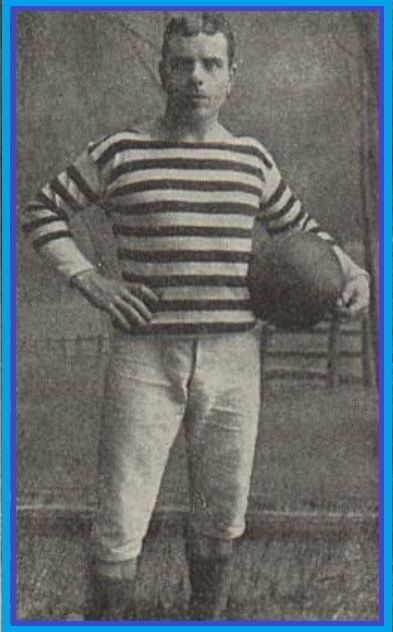
Iceland's James B. Ferguson in 1895
James B. Ferguson and Frank McGregor - football is said to have arrived in Iceland in 1895. It came in the form and feet of James B. Ferguson, said at the time to be aged twenty-two, to be from Glasgow and in Reykjavik, working for a local printer. There is even a photo, football under arm, of him as he introduced not just "soccer" but also gymnastics.
But that is it. There is no hard indication of his story before or after 1895 just as there is none of a second Scot, Frank McGregor, said to be an Engineer and recognised as the founder just four years later in 1899 of Iceland's first football club. KR. Again can you help?
----------------------------------------------------------------------
Projects

The Joseph Taylor Grave
Restoration work on the grave of Joseph Taylor has been completed. And it and a new, marble plaque were unveiled on 13th April by two of his great-grandsons, Colin and Alex Taylor, in a ceremony at Glasgow's Cathcart Cemetery, also attended by SFHG members. The Daily Record was there too and the following day it published the excellent "Memory of Scottish football legend protected after revamp of historic grave". - AF
More Notable Research and Restoration So Far by Others with SFHG Input



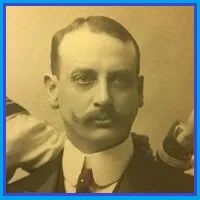
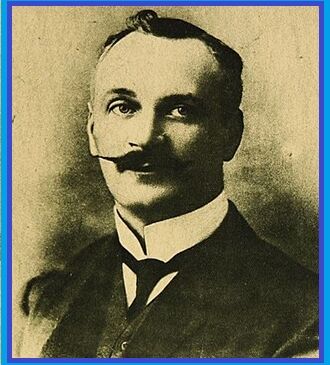

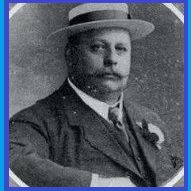

Where others are
From the World's first official football international played in Glasgow in 1872 and the beginning of the Second World War almost six hundred Scots-born players turned out for the national team plus a number who were born elsewhere. Most lived out their lives on and are buried in Scottish soil and one of our aims here at the SGHG has been to trace and track them and their last resting places so that the contributions of as many as possible to our national game can continue to be recognised, honoured, marked, maintained and, perhaps, become places of quiet pilgrimage. To that end we begin with the seven cemeteries/crematoriums, where more are buried or were cremated than any others. They are in Scotland:
But, of course, as has been the way of Scots from all walks of life movement abroad has been frequent and in many cases permanent so trace and track is not confined to our immediate frontiers. Indeed, three English locations stand out as the final resting place, the burial or cremation, of a remarkably large number of our own. Those places are:
To see who is to be found where simply click on the individual resting-place and then, for their personal stories, on the "People" list below.
and here is.....
The dilapidation of the graves of Scotland's international footballers is an on-going problem. In part it is neglect but mostly simply climate and weathering. The only ones to avoid the effects is the small number that are unmarked and deserve recognition. So the SFHG group, mainly through the unstinting efforts of founder member, Martin Donnelly, having already created the most comprehensive listing of the last resting-places of those who represented us on the football-field from 1872 until the Second World War, a list that will be constantly up-dated until complete, has also turned its attention to the dozen most urgently in need of the same. Each will require up to £5,000 to carry out the necessary works and we invite you to contribute. It can be done through the Honesty Box below. |And the graves are:
The Grave Situation
David Wotherspoon, Southern Necropolis, Glasgow, Billy Mackinnon, Westburn, Cambuslang, Thomas Highet and William Russell, Cathcart Cemetery - graves unmarked
- West Kilbride, Ayrshire, condition of grave declared to be dangerous.
- Methilmill, Fife, gravestone unstable
- Lochgelly, Fife, gravestone crumbling
Andrew Richmond, Craigton, Glasgow and John Gow, Cathcart, Glasgow
- both gravestones facedown and therefore unreadable.
Eddie McBain, Hawkhead, Paisley and John Goudie, Hawkhead, Paisley
- gravestones laid flat since last visit.
Willie Berry, Western Necropolis, Glasgow, Bobby Templeton, Kaimshill, Kilmarnock and Tom Jackson, Eastwood Old, Glasgow
- gravestone/cenotaphs in two pieces.
However, this is what we have been able, with help, to do so far with more to come as donations allow.

Andrew Watson, Richmond Cemetery, London

Joseph Taylor, Cathcart Cemetery, Glasgow

Robert Parlane, City Cemetery, Belfast
----------------------------------------------------------------------
History
Home and Beyond
First there is a number of thoughtfully compiled and curated Scottish club archives that are always an excellent resource. For a list of those known to us and for your ease of access, click on;
plus, as an attempt to cut through the hyperbole of the over-vested interests, not least parochialism and even blinding nationalism, and to be use in conjunction with,
The Timeline of Association Football
there is our new and always developing,
SFHG Supplementary Football/Scottish Football Timeline
and then, on 30th November 2022 the Scots Football Historians' Group became "live" and work began. The date was deliberately chosen, for two reasons, both symbolic. The first is that it is St. Andrews Day, with Burns Night one of two that are uniquely both Scottish at home and Scots elsewhere. The second is that, as the twenty-second World Cup with its sixty-four international encounters is taking place three and half thousand miles away, precisely one hundred and fifty years ago the first such meeting of footballing nations took place and in Scotland, in Glasgow at the still existing Hamilton Crescent cricket ground. Indeed, although it was a 0-0 draw, the first of many since, it can easily be argued that without that specific game none of what is taking place over a month in the Middle East would be happening at all. Whilst the birthplace of Association Football, forever England, could even then have raised a representative team in a moment, without opposition the game might have withered on a still very slender vine. That it survived is very largely due to a group of eleven young men, amateurs all, a Glasgow-suburbs club team in essence, who were ploughing a very lone furrow North of the Border, which took on the challenge from the South, were expected to be dubbed, with tactical nous acquitted themselves remarkably and instead sparked an explosion in enthusiasm that continues to this day worldwide. Those eleven young men were,
William Ker and Joseph Taylor,
James Thomson and James Smith,
Robert Smith, Robert Leckie, Alex Rhind, Billy Mackinnon, Jerry Weir and David Wotherspoon
and with them the story of the SFHG begins. Over the last few years through the worldwide research of a small number of thorough football historians in Scotland and elsewhere a deeper understanding and therefore an alternative interpretation of the history of the "Beautiful Game", of Soccer has emerged. There is no doubt that Association Football was an English invention, an amalgam of several traditions and codes from various parts of that country. But it was in large measure not the versions, albeit to the same rules, that became firstly that of the working-man and was within two generations taken round much of the World and within little more than a third to the entire globe. That was the then very much pre-eminent "Scottish Game", the seeds of which were actually sown on that day at the very end of November 1872.
We know, through research old and modern, where all of the "Class of 72" were born. They came from a number of corners of our country. We know where all but one of them rest, five in home soil from Cambuslang to Inverness, five like so many of our fellow countrymen in foreign fields, England, the United States, Australia and South Africa. But each one deserves to be properly recognised and physically honoured as a group and individually and that at least in spirit that is what we did last evening. In these modern times where communication is more often than not virtual we all sat down together for the first time and had a dinner to mark the importance of the event of precisely a century and half ago, all those in football that have followed on since and what might be described as our formal foundation. And we did it in the presence of special guests, Colin and Alex Taylor, the great-great grandsons of Joseph Taylor, on the right of the unprecedented full-back pairing in that first Scotland team and later President of the club team that formed it, not the first but arguably the footballing World's most important club team, Queen's Park.
But, of course, The Spiders, its players and Hampden were not alone. There were and have been many other players, officials and administrators, locations and events, individually and which we have linked.
People
Just under six hundred Scots have until the Second World War, the football history, in which we are most interested, played for the national team. These were days when international games took place annually but in nothing like modern numbers. Today Kenny Dalglish holds the record for appearances with 102. But then it was Alan Morton with thirty-one and he had an international career that lasted twelve seasons; just one of the stories that we consider still worth telling. For others, click HERE.
Places
It can never be said that Scots football, that is the game in Scotland, the Scottish game, and the sport as carried by Scots round the globe in head and feet, was a slow burner. It exploded both here and there. Within half a decade of 1872 and one club at home teams were numbered in hundreds and within another five years Scotsmen were playing and, importantly, organising football from Wales to Canada in one direction and China in the other. It was a contagion and stories of its spread are HERE.
Matches
The story of Scots and football, indeed of Scots and soccer more generally, is littered with games literally of pivotal consequence. The Glasgow international of 1872 was just the first. But there would be many others, several of those of the first World Cups to 1950 and in between many more, in Britain and Europe but notably also in Africa and the Americas, both South and North. As we and football historians around the World uncover more and more detail accounts are added to and can be found HERE.
History Trails and Tales
Across Scotland and, indeed, the World the origins and influences of Scots and their football at home and abroad are to be found everywhere. And sometimes they are in concentrations that can be linked to form a series of trails that will lead you both though histories and places that are unique to our and the World game, to us, ours, you and yours.
Scotland
______________________________________________
______________________________________________
(Kinross & West Fife, The Fife Coalfield, North Fife, The Fife Coast)
_______________________________________________
_______________________________________________
and
_______________________________________________
(Alexandria, Renton & Dumbarton)
and now:
_______________________________________________
____________________________________________
Glasgow Football's Square Miles +
(Early, Central & Southside, Queen's Park & Crosshill and Cathcart)
_______________________________________________
(From Eaglesham to Hampden,
Kilbarchan via Paisley to the Clyde
and the Glasgow Southern Suburbs in-between)
_______________________________________________
______________________________________________
The Greenock (& Gourock) Trail
______________________________________________
______________________________________________
(Galston, Newmilns and Darvel)
______________________________________________
(Bellshill, Motherwell, Wishaw, Newmains, Cleland, Carfin & Holytown)
______________________________________________
England's Scottish Teams
(Coming soon)
______________________________________________
The Diaspora
____________________________
____________________________
____________________________
____________________________
____________________________
Scots Sources of the Spanish Game
and
(The Scots, who pioneered the Spanish game)
____________________________
In the USA
and
The New England Trails
____________________________
Scots Sources of the Latin American Game
____________________________
The Men Who Made Argentine Football
and
(The twenty one Scots, who made the Argentine game)
____________________________
The Men Who Made Brazilian Football
and
(The six Scots, who made the Brazilian game)
______________________________
The Men Who Made Chilean Football
and
(Scots and the Chilean game)
_______________________________
The Men Who Made Uruguayan Football
_______________________________
----------------------------------------------------------------------------------------------------------------------------------------------------------------------------------------------------------------
More Recommended Sources
Scottish Sport History
If there is one there is one web-site that has been an inspiration for what the SFHG is trying to provide, comprehensive research into fitba', our football, at home at abroad, it is Andy Mitchell's Scottish Sport History. Since 2012, so for more than a decade, he has produced a veritable stream of impeccably accurate articles and books on many aspects of Scottish sport and Scots in it. It is he, for example, who rediscovered the grave in London's Kew of Andrew Watson. And, although he is not a member of the SFHG, he is seen by us with regard to football as very much a "fellow traveller". So, if you have not done so, please visit his site now by clicking below on:
Andy Mitchell's Scottish Sport History
And we avidly recommend you purchase his definitive Who's Who of all the players, who represented Scotland from the first International game in 1872 to the start of the Second World War. See, buy and read
And there is more.............
For up to two decades a small, dedicated group of enthusiasts has worked away largely without the recognition they deserve compiling data on both Scottish senior and junior football, male and female. They have delved into every aspect of each - clubs, games, players, crowds, trophies - and it is equally available to all for use, support and sheer admiration on:
The Scottish Football Historical Results Archive
plus there is the ever-growing Scotland the Grave, the work of SGHG member Martin Donnelly, with other members Alistair Firth and Mandy Higgins and other chipping in, its records the final resting places of those who have played for the Scotland National Team.
https://www.facebook.com/ScotlandTheGrave/
Very much worth keeping up with too is the personal blog of Richard McBrearty, the Curator of the Scottish Football Museum. He is delving deeply into what exactly is on the tin at:
There is also the work of Stewart Mathers, which covers in detail the Scottish Cup and other subjects on his web-site:
and the historian of football in Sheffield, Steve Wood, has, amongst his wide range of excellent research, books etc., posted this self-explanatory video,
How Scotland United the Rules of Football.
Click on all or any to view.
______________________________________________
Thinking and Thinking-On
and again if you find this site interesting and use any of its content, please remember that both research, plaques and particularly preservation and restoration do not come free,. So, if you can make a contribution generally via founder member, Alistair Firth, to SFHG funds rather than a specific appeal, one commensurate with the value you have extracted from our work so far, then do not be shy.
Alistair is pictured above on the left, holding the flag with Joe Taylor's great grandson, Colin Taylor, on the right. Account details are to be found here by clicking on:
____________________________________________
See also a book of interest that is not Glasgow nor even Central Belt:
"36-0: The story of John Petrie and the Arbroath men who made world footballing history."
Contact
And perhaps you also have more information to add or personal stories to relate. If so, please contact us on:
E-mail: contact@thescotsfootballhistoriansgroup.org
Or outwith Scotland you might like to pass on that information or perhaps put a question to a reputable historian in the country in question. If so, please see our list of Associate Members.
______________________________________________